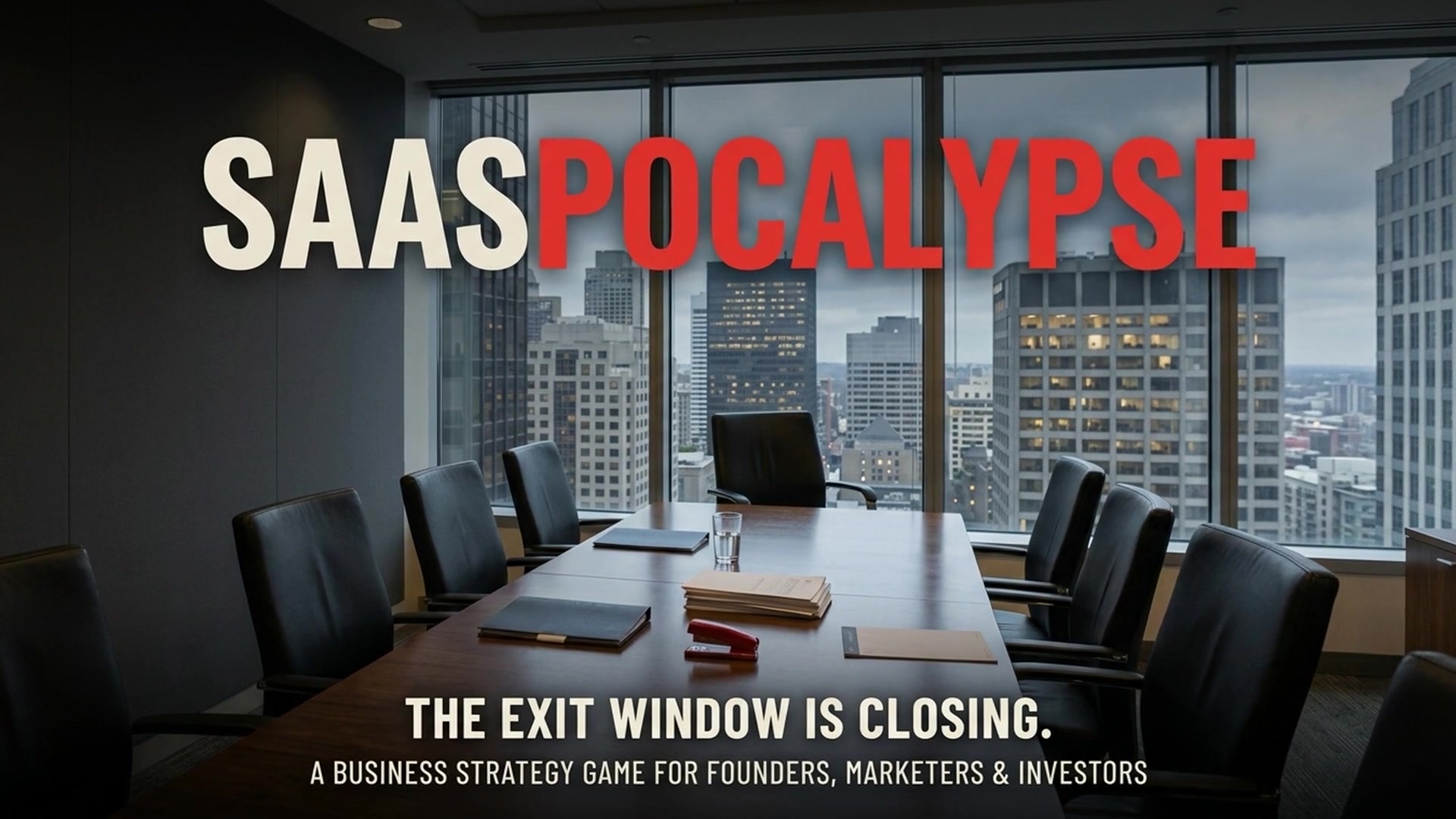
AI is reshaping SaaS. Boards want results. Investors want an exit. SaaSpocalypse is a business decision game for founders, marketers and investors facing AI disruption: pressured portfolios, delayed exits and a board demanding results. Practice the decisions that determine who adapts, who survives, and who loses their seat.
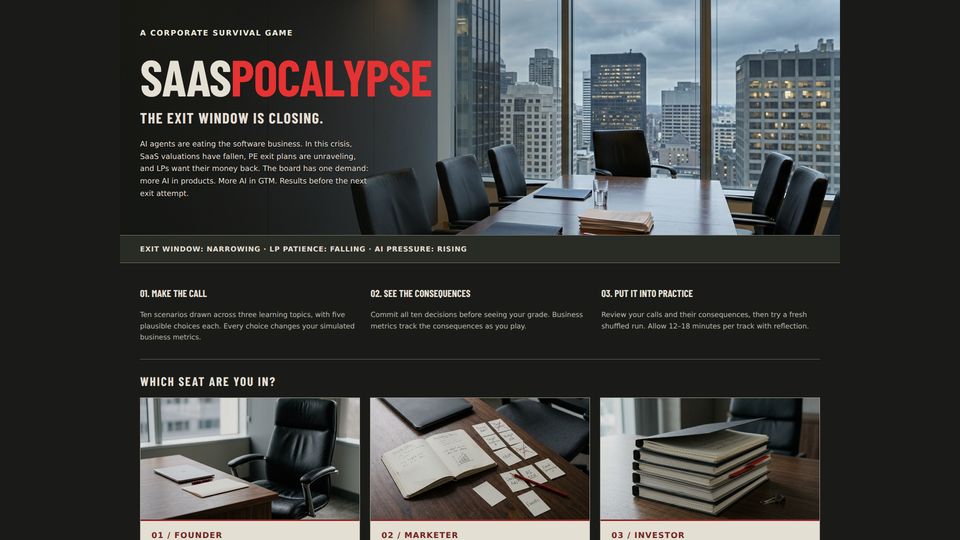
SaaSpocalypse is a business decision game for founders, marketers and investors facing AI disruption. The setting: SaaS valuations have fallen, PE exit plans are unraveling and LPs want their money back. The board has one demand: more AI in products, more AI in go-to-market, results before the next exit attempt.
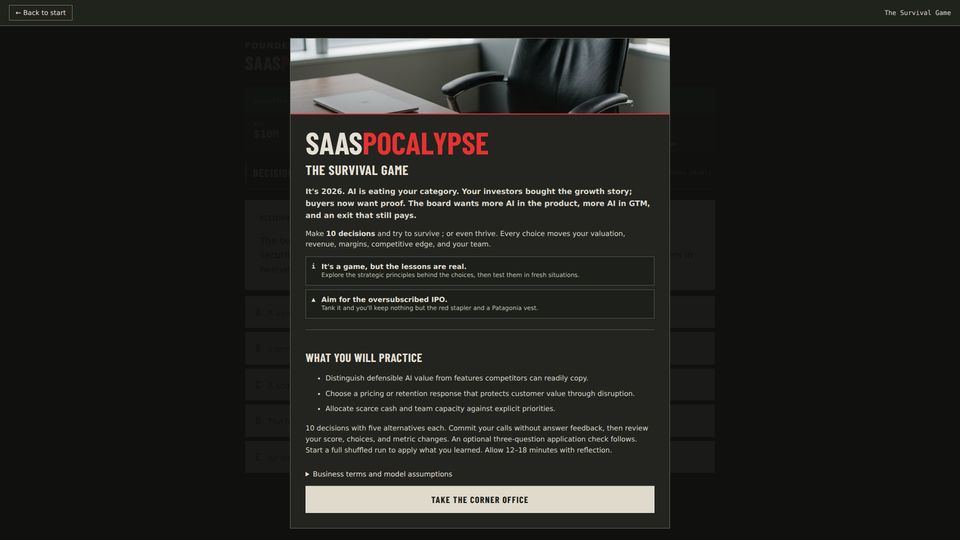
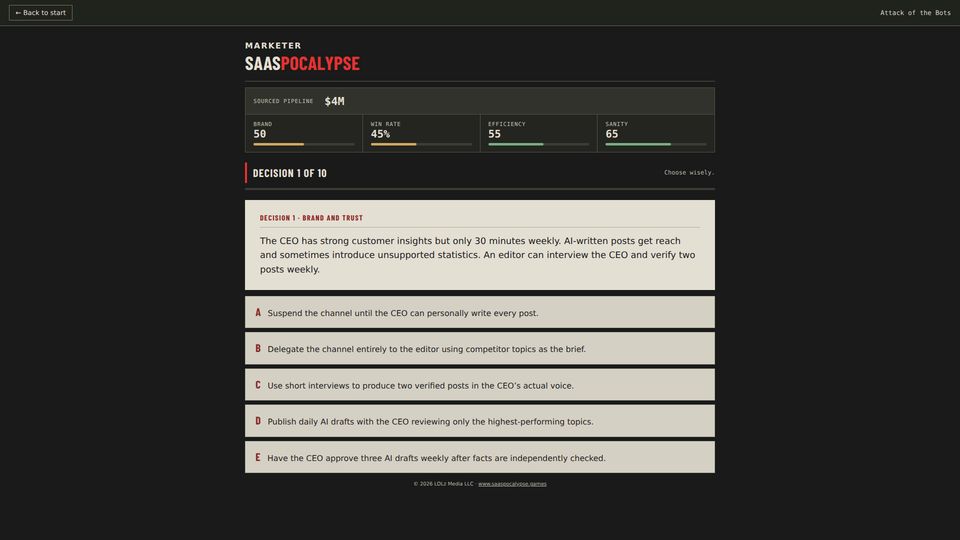
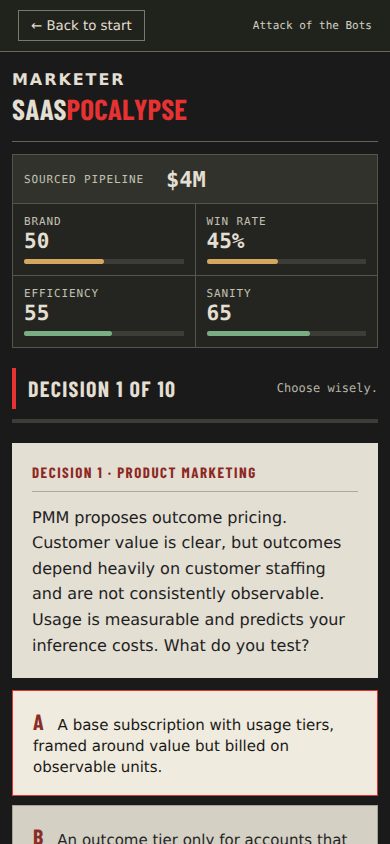
Each run draws ten scenarios from a bank of 22 for your seat. Every scenario offers five credible choices — plausible things a real operator might do — and every choice moves your simulated valuation, ARR, margin, competitive edge and team morale. You commit all ten before you see a grade. Then the game shows what each call cost, what it earned and what a stronger answer would have been.
Distinguishing useful AI transformation from costly AI theater. Weighing short-term gains against customer value, durable differentiation and execution risk. Matching a strategy to the constraints in the scenario, then using feedback to improve the next call.
The vendor bundle that solves the board's slide and nobody's problem. The pilot budget spent on a consulting deck. The AI feature announced before it works. The pipeline number that will not survive buyer diligence. The exit chased a quarter too early.
Every choice is rated against an authored rubric: strongest fit, well supported, partial fit, significant exposure, poor fit. The review explains only the choices you made; the unchosen answers stay unrevealed, so the next run is still a test.
Sixty seconds: the briefing, the boardroom pressure, a decision on the clock, and the ending that follows.
Each run draws ten scenarios from a bank of 22 per track, across three learning topics. Five plausible choices each — the tradeoffs matter, not the trick answer. Business metrics move as you play.
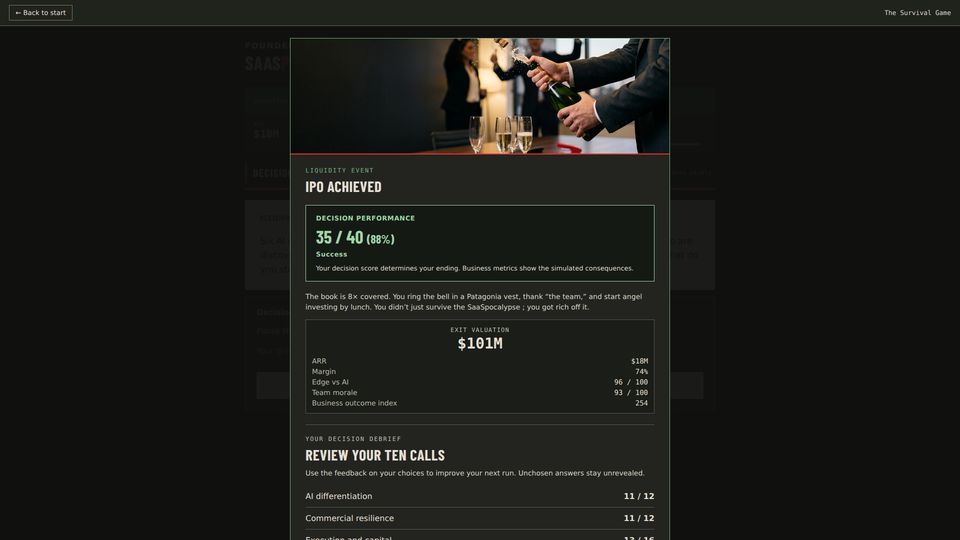
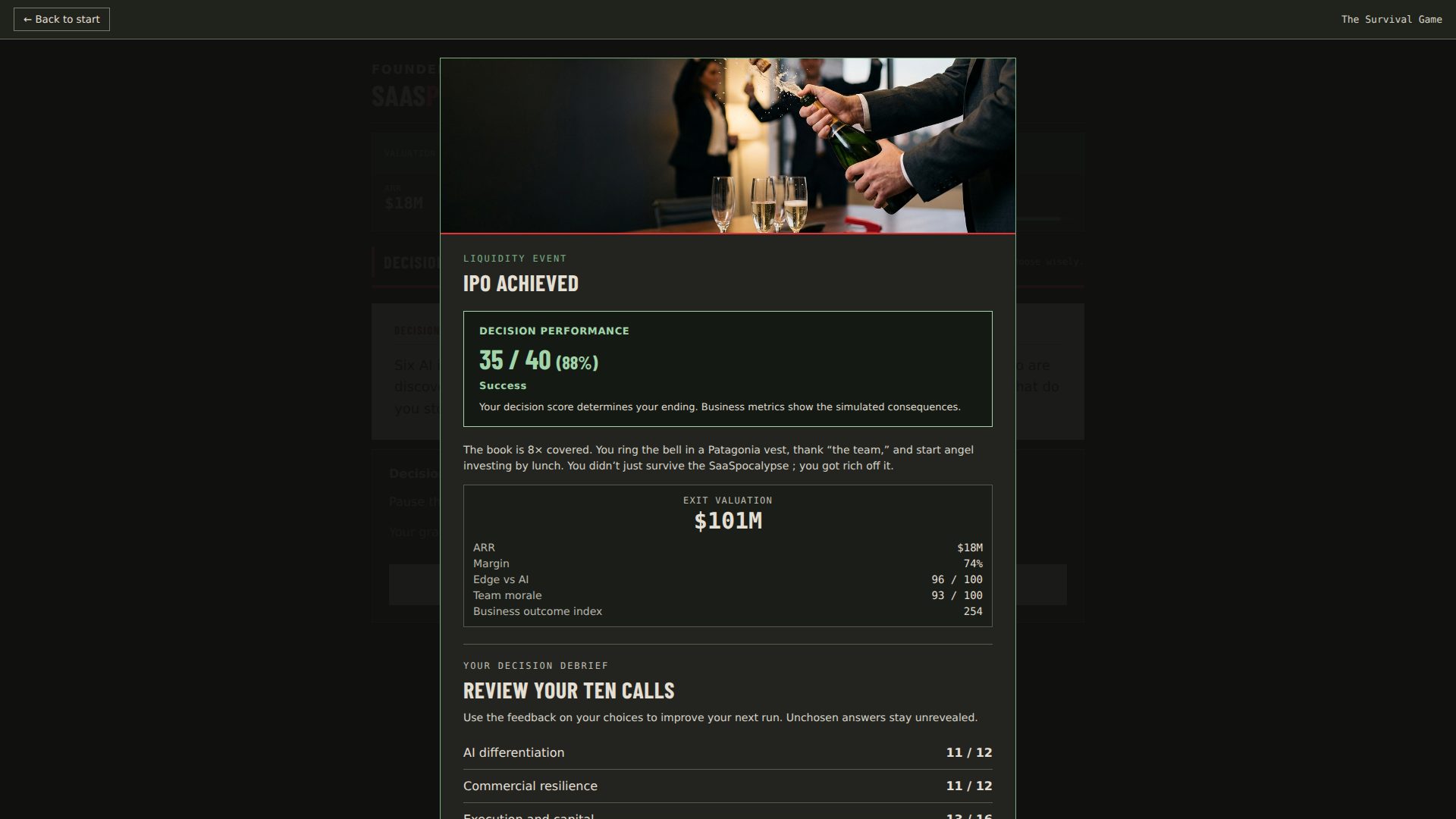
After all ten decisions, review your chosen responses: colored grades, points, explanations and the actual metric gains and losses. Unchosen answers stay unrevealed.
Start a full new run with shuffled scenarios and answers. An optional three-question application check follows the review and withholds feedback until it is complete.
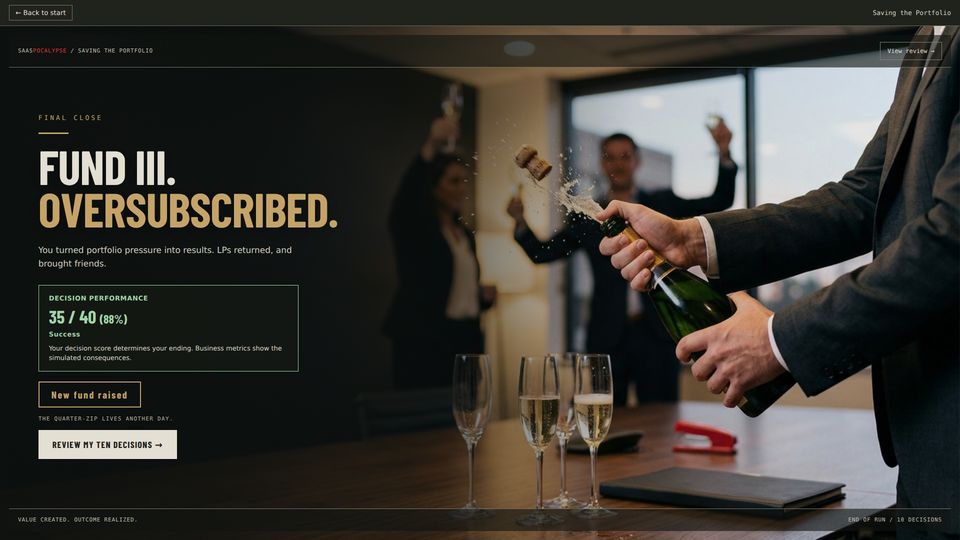
Every choice is scored 0–4 against an authored rubric. Ten decisions, forty points, one of four endings.
Decisions are committed one at a time and the grade is withheld until all ten are in. You cannot peek, undo or A/B your way through — the same way a quarter works.


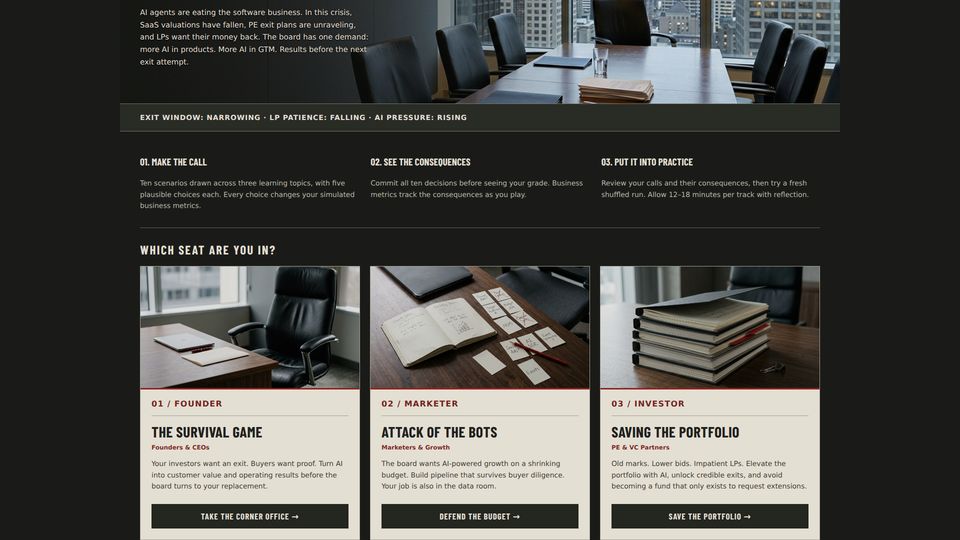
Your investors want an exit. Buyers want proof. Turn AI into customer value and operating results before the board turns to your replacement. Balance product differentiation, commercial resilience, execution and capital.
The board wants AI-powered growth on a shrinking budget. Build pipeline that survives buyer diligence, defend trust, and sharpen positioning when AI changes the buying conversation. Your job is also in the data room.
Old marks. Lower bids. Impatient LPs. Navigate AI value creation, capital allocation, exits and fund decisions across a portfolio — and avoid becoming a fund that only exists to request extensions.
Ten decisions, forty points. Your total decides which of four endings you get; the business metrics show the simulated consequences. Then the debrief: every call you made, its grade, the lesson, and the metric deltas — with a downloadable report if you want one.
IPO, CMO, or a new fund raised.
Survived, role retained, capital returned.
Reduced-valuation sale, reassigned, fund extended.
Company, role or fund gone.
Formative, not certified. Results use an authored formative rubric, not a validated proficiency assessment. Business metrics and consequences are illustrative. Use the review to discuss which assumptions would change the preferred answer.

A strategy offsite takes a day, a facilitator and a room full of people who already agree. This runs on any laptop, in under twenty minutes, and no two runs ask the same ten questions.
Every choice is something a competent operator might do. The rubric rewards the best fit for the constraints in the scenario, and the review explains why the alternative you picked cost what it cost.
Use it for individual practice, or put a track on the screen and argue every decision as a team. Learning objectives are stated up front so a facilitator can anchor the discussion.
Your portfolio's situation, your company's metrics, your firm's language. Scenarios, choices, rubric and endings are data, and can be re-authored for a firm, a portfolio company or a program.
The game is a single HTML file that runs in any modern browser, online or offline. No accounts, no analytics, no external assets, no IT ticket.
Grade, ending, metrics, per-decision feedback and objective scores appear the moment the run ends, with an optional report download for the player's own records.
The same file runs on a phone or tablet for a quick solo run between meetings. The desktop layout is the one to use for a group session on a screen.
All three tracks — Founder, Marketer, Investor — as a single offline file. Play any seat, replay with a fresh draw, download your report.
Available nowSite-wide use for a firm, portfolio, cohort or classroom, with facilitator notes: objectives, score bands, the four endings and what to look for in the review.
Available nowYour portfolio, your metrics, your language. Scenarios, choices, rubric and endings re-authored for a firm, a portfolio company or an executive program.
Request a quotePlayable build, trailer and the evaluator walkthrough available on request. Tell us about your team, firm or program and we will get back to you.